Having completed hundreds of raw land deals covering thousands of acres, it is safe to say the hardest part is getting paid (selling the asset). Land is a highly illiquid asset in weak or mediocre markets, but investors can generate significant returns when selling land in high-demand markets.
Buying land is easy, especially in weak markets. However, the risk is buying too far ahead of a rising market, which can result in holding the asset for an extended period.
That is why HousingAlerts was created. Our predictive capabilities are designed to put investors in the sweet spot of catching markets at the perfect time: not too early, and not too late.
The Problem with “Hot” Markets
When the general public identifies a market as “hot,” they are usually looking in the rearview mirror. They see that prices have already skyrocketed, bidding wars are everywhere, and inventory is wiped out. Buying into that kind of hot market is widely recognized as a terrible strategy, especially for raw land.
However, when we define a “hot market” using our Precision Market Tracker, we are not reporting what has happened; we are predicting what is going to happen next.
A Predictive Case Study: Abilene, TX
Let’s look at a clear example from Abilene, TX.
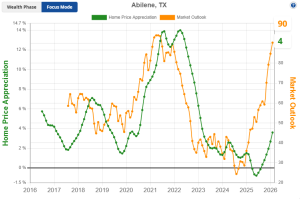
Back in August 2020, the actual home price appreciation in that market was sitting at a very balanced, reasonable 4.36%. To the average investor, it looked like a calm, standard market. But our predictive Market Outlook score had already spiked to 72. We were flagging it as a “hot market” 6 to 12 months before the masses caught on.
Investors who trusted that predictive score were able to get in at reasonable prices before the market exploded to 14% appreciation over the next year.
Right now, we are seeing the exact same pattern repeat. Actual appreciation in Abilene is currently low, but our Market Outlook score is hitting 90. Because we have been refining this data at the metro level since 2006, we know this indicates Abilene is a hot market right now. This gives investors the cheat code to enter the market before it looks hot to everyone else.
How This Applies to Raw Land Specialization
Because land is the most sensitive asset class to market cycles—being the first to drop and the last to recover—having a predictive leading indicator is arguably more critical for land investors than for residential buyers.
Here is how you can use the Precision Market Tracker for a raw land strategy:
-
Time Your Entries: For strategies that target a balanced market growing at a reasonable rate (the early recovery phase), use our predictive scores to find metros that are just starting to turn upward. This allows you to buy land before the residential boom drives up your acquisition costs.
-
Know Your Zoning Timeline: If you purchase commercially zoned land, remember that it lags behind the residential market. You can use our residential data as a crystal ball to predict future commercial demand. Conversely, if you buy rural or outer-rim land, it will closely follow residential patterns.
-
Protect Your Downside: When our Market Outlook score peaks and starts trending down, you will have a 6 to 12-month head start to sell your parcels before the local market cools and liquidity for raw land dries up.
Everything comes back to the market cycle. The ultimate goal is to leverage data to front-run the market cycle, rather than simply reacting to it.